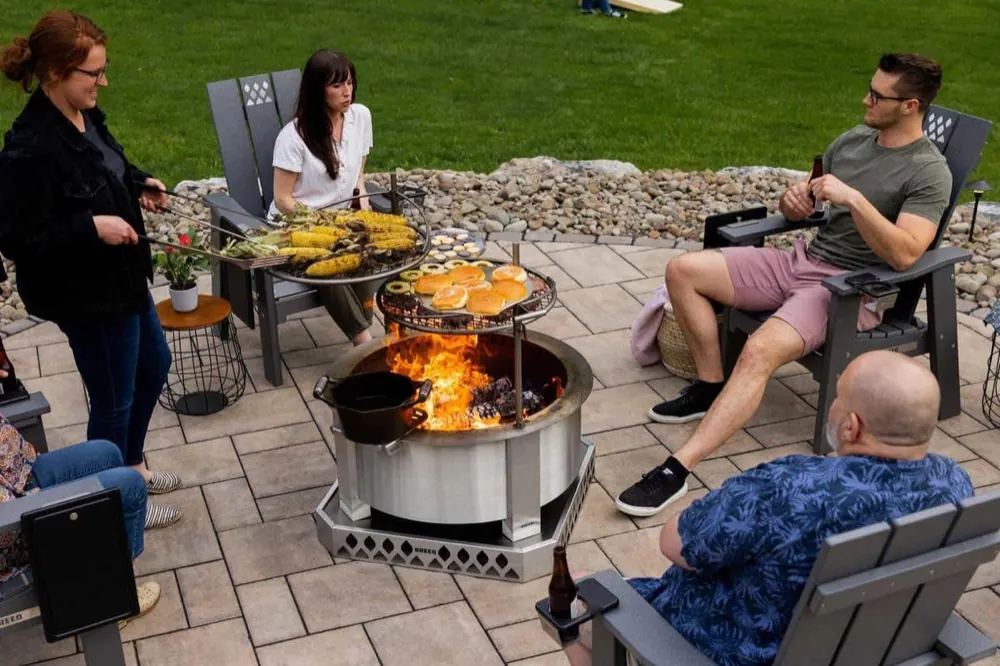
Backyard fire · How it works
Every smokeless fire pit smokes for the first fifteen minutes. Here is what happens next.
Secondary combustion is physics, not marketing. It also explains why two pits burning the same wood behave nothing alike.
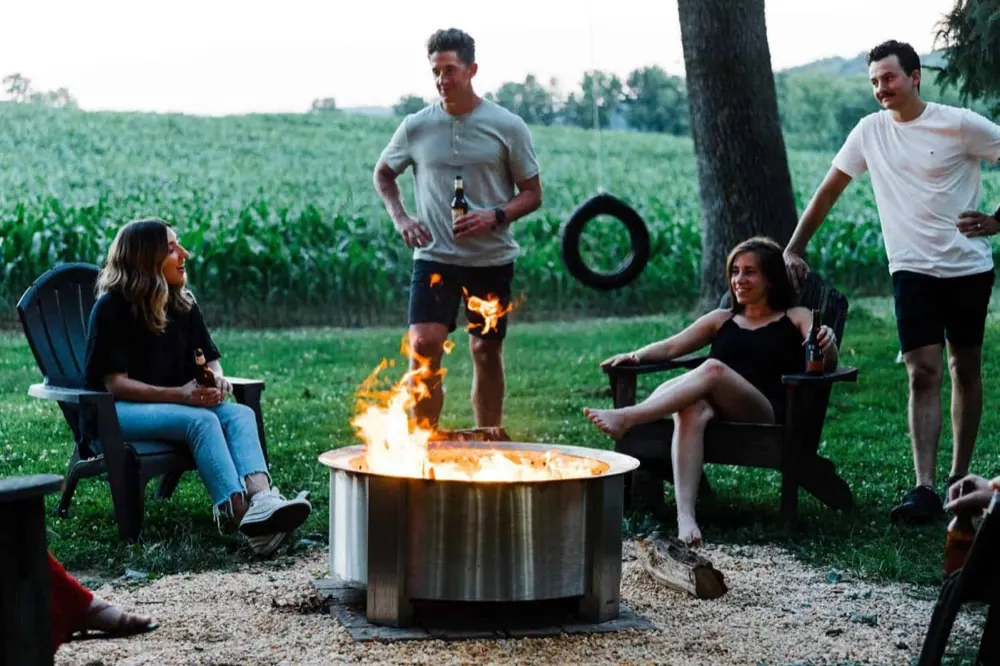
Ask anyone who owns a wood fire pit what they hate about it and you will not hear a word about heat, or ash, or the price of a bundle of oak. You will hear about the smoke, and specifically about the way it seems to choose a person. You move your chair. It follows. You move again. Ten minutes later you are standing up, holding a drink, on the far side of the fire from everyone you came outside to talk to.
The category that grew up to fix that problem is called smokeless, which is a promise big enough to make anyone suspicious. So here is the honest version, in the order it actually happens: what smoke is, what a double wall does about it, why the first quarter of an hour looks like any other fire, and where the differences between one pit and the next actually show up.
The problem
The rotation game
Read enough owner reviews of any fire pit and the same scene keeps coming back, written by people who have clearly never met each other. Two of them, published on Breeo's own product page this year:
Our family can now enjoy a fire in the evening without the need to constantly rotate our seats to avoid smoke. Verified buyer, X24 Corten Steel, June 10, 2026 · published on breeo.com
We aren't getting smoked out or playing the rotation game of "where can I sit and not get smoke to the face". Owner review, X24, April 25, 2026 · published on breeo.com
Nobody buys a fire pit to solve a seating problem. They buy it for the evening that the seating problem keeps ruining. That is the whole job, and it is worth understanding how a piece of folded steel with no moving parts and no power cord manages to do it.
The physics
Smoke is fuel you failed to burn
This is the part most people get backwards. Smoke is not a by-product of fire the way ash is. Smoke is wood gas that left the fire before it got hot enough to ignite. Heat a log and it does not burn directly. It bakes, and it releases a cloud of flammable vapor. If that vapor meets enough heat and enough oxygen on its way up, it burns and you see flame. If it does not, it cools, condenses and drifts away as the gray stuff that finds your eyes.
Breeo says the same thing on its own explainer page, in one sentence, without a single adjective:
Fires smoke because of three reasons: lack of heat, lack of oxygen, or the wrong fuel. The key to a smokeless system is creating more airflow and burning a hotter fire. Breeo, How we're smokeless
Not enough heat
Wood gas needs a hot zone to ignite. A cool, lazy fire produces vapor faster than it can burn it.
Not enough oxygen
Choke the air supply, usually with a bed of ash, and combustion goes incomplete on its own.
The wrong fuel
Water in the wood absorbs the energy that should be igniting the gas. Wet wood smokes in anything.
Two of those three are design problems. The third one is yours, and no fire pit on earth fixes it. Hold that thought, because it comes back later and it is the reason honest owners give five stars and a warning in the same paragraph.
The mechanism
What a double wall actually does
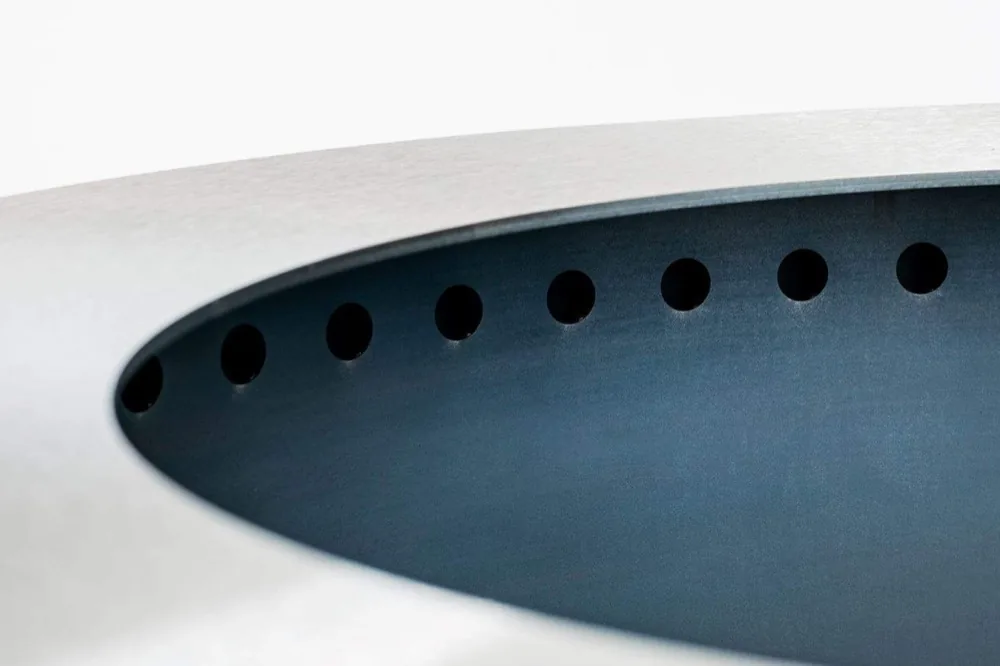
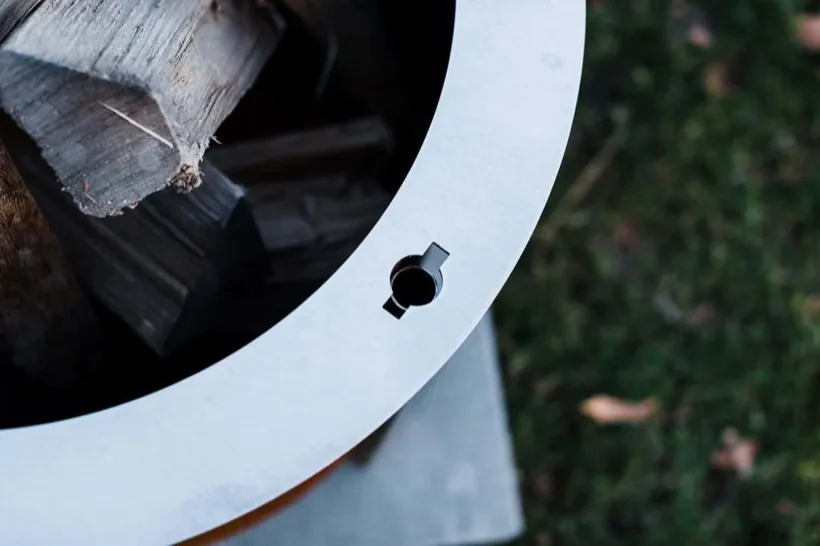
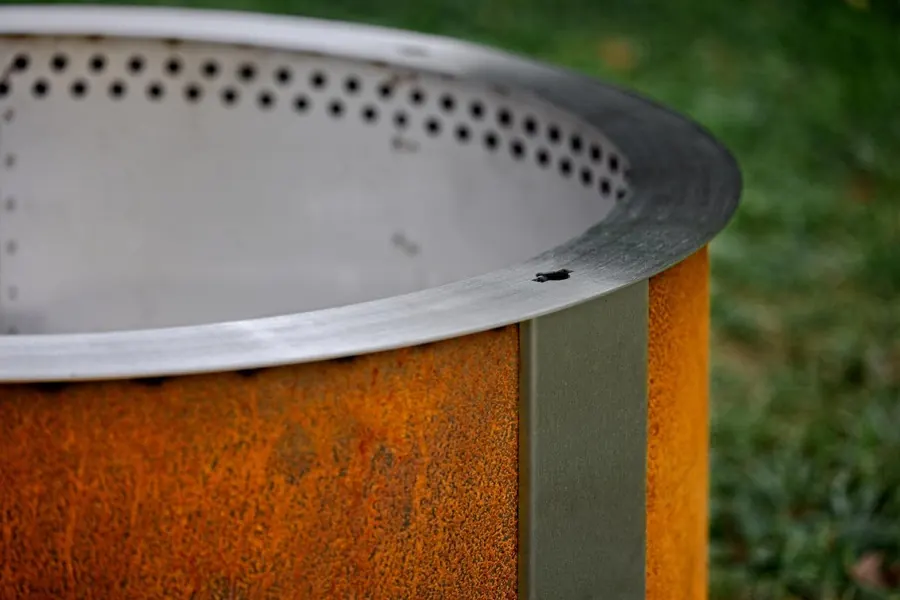
The trick is not a filter and not a fan. It is a chimney built into the wall of the pit itself. Cold air is pulled in at the bottom of the outer skin, travels up the narrow cavity between the two walls, and gets cooked by the fire on the way. By the time it reaches the top it is no longer cold air, it is pressurized hot oxygen. It exits through that ring of holes under the rim and lands straight in the column of unburned wood gas leaving the fire.
That is the second fire. The industry calls it secondary combustion, or reburn. You can watch it start: the flames stop being ragged and orange at the top and begin to look like they are being blown sideways into themselves.
Breeo breaks it into three steps on its site. Their wording, quoted as published:
-
X Airflow, the raised vent
"The X Airflow raised air vent design on the bottom of the fire pit enables oxygen to feed the fire even after significant ash build up."
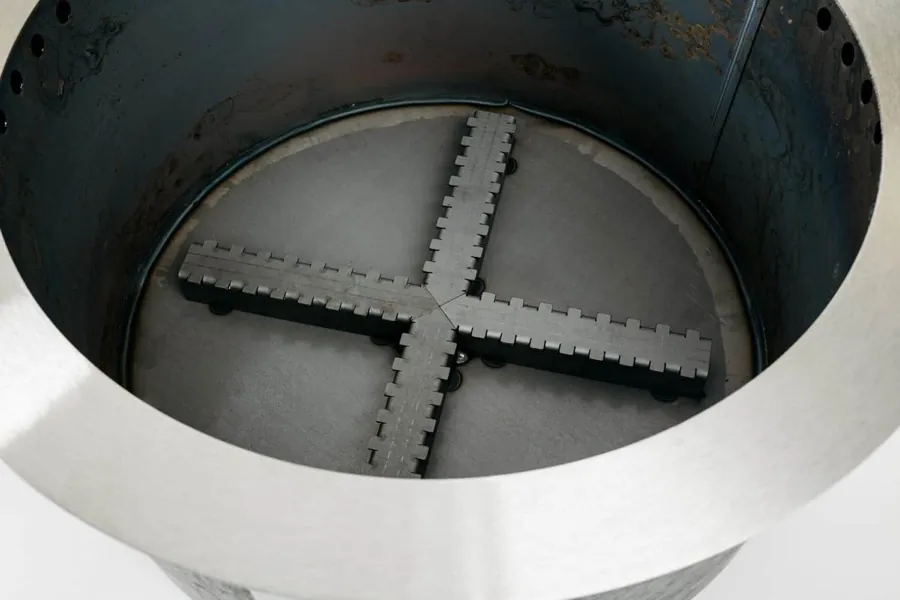
The vent is the cross you can see standing proud of the floor. Ash falls around it instead of sealing it. -
Double wall, the chimney
"Air enters a cavity at the bottom into the double wall while the fire heats the walls. Hot air rises through the gap between the two walls as the fire burns."
Nothing pushes that air. Hot air is less dense than cold air, so it climbs on its own and pulls more in behind it. The wall is doing the work of a fan, powered by the fire it is feeding.
-
Secondary combustion, the reburn
"The hot air then exits the double wall through holes around the rim. This pressurized, heated oxygen mixes with the smoke and causes secondary combustion or reburn."
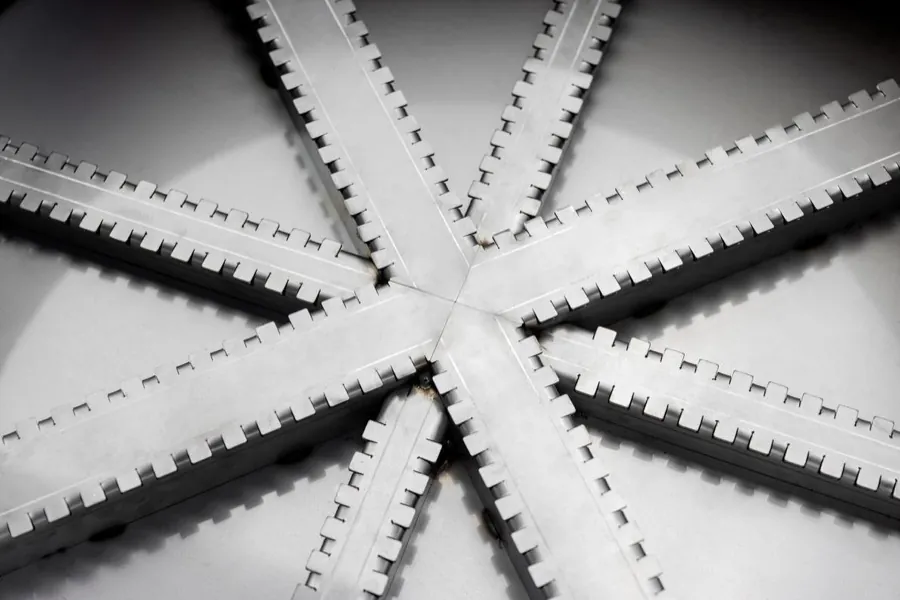
Same ring, larger pit. The holes point into the chamber, not out of it.
Two of the five product features Breeo lists on that page describe exactly this hardware: "Patented X Airflow technology" and "double wall construction and secondary combustion holes allow for a smokeless burn". There is no fourth secret. The entire product is a shape.
The honest part
Why the first fifteen minutes look like any other fire
Reburn only runs when the wall is hot. Light a cold pit and for the first stretch you have a fire in a steel bowl, with the same drifting gray as the fire ring at a campsite. The cavity has to come up to temperature before it can deliver hot oxygen instead of cold air. Owners describe this consistently, and they are more precise than any brochure would dare to be:
I will say you need to get it up and running for 15 or so minutes before you can really call it smokeless, but after that initial burn takes place, we could not see ANY smoke at all. Verified buyer, X30 Stainless Steel, March 1, 2025 · published on breeo.com
Works as advertised, 15-20 min to heat up then no smoke. First fire my wife sat at and didn't have to worry about smokey smell afterwards. Verified buyer, X24 Corten Steel, June 3, 2023 · published on breeo.com
Minute 0 to 5
Kindling stage. Cold steel, cold cavity, ordinary smoke. This is the part people film and then delete.
Minute 5 to 15
The walls load up with heat. Draft builds in the cavity. The plume thins out and starts to lean.
After 15
Reburn is running. Flame tops flatten and brighten. Nobody has moved a chair in ten minutes.
The other half of the honesty is the fuel. The mechanism supplies heat and oxygen; it cannot remove water. Damp wood spends its first minutes boiling instead of burning, and a fire that is busy boiling is not hot enough to run a reburn. Owners say it plainly, including in five star reviews:
As long as the wood is dry/seasoned the fire is relatively smokeless. If you put wet wood on the fire, you will get smoke. Verified buyer, X24 Corten Steel, November 24, 2025 · published on breeo.com
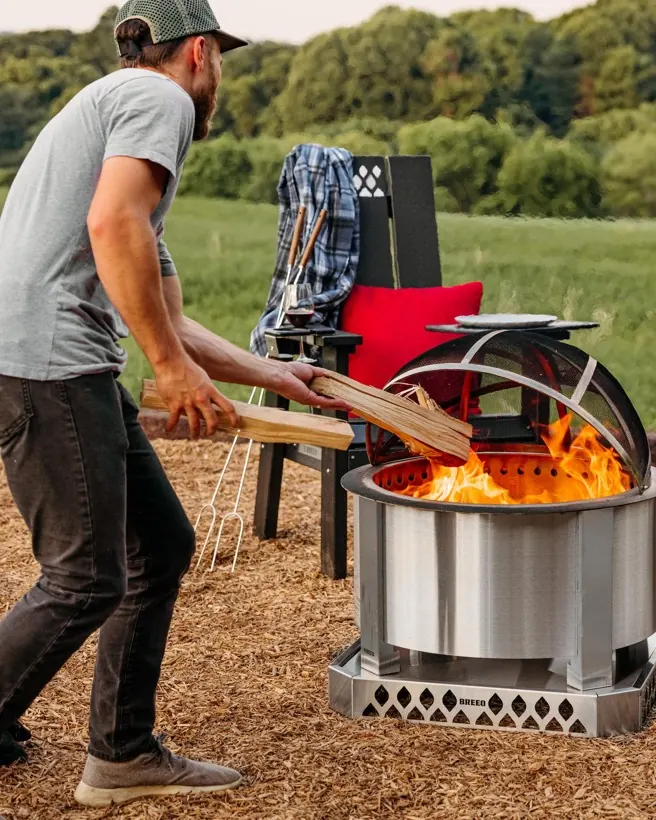
This is also why Breeo publishes a recommended log length for every size, which is an odd thing to find on a product page until you understand the mechanism. Wood that is too long for the chamber sits across the hot zone and smolders at the ends. Wood that fits burns in the middle of the heat where the reburn can reach it.
Where pits differ
Same principle, very different steel
Every double wall pit on the market works from the physics above. What separates them is what the wall is made of and how much of it there is, and that turns out to matter more than the brochure copy suggests.
Mass is the reason. A thin wall heats fast and cools fast. A heavy wall takes longer to come up, then holds temperature through the part of the evening where a lighter pit is coasting, and radiates that stored heat sideways at the people sitting around it rather than losing it up the middle. It also shows up at the rim, which is either something you drop a split onto without a second thought or something you learn to handle carefully.
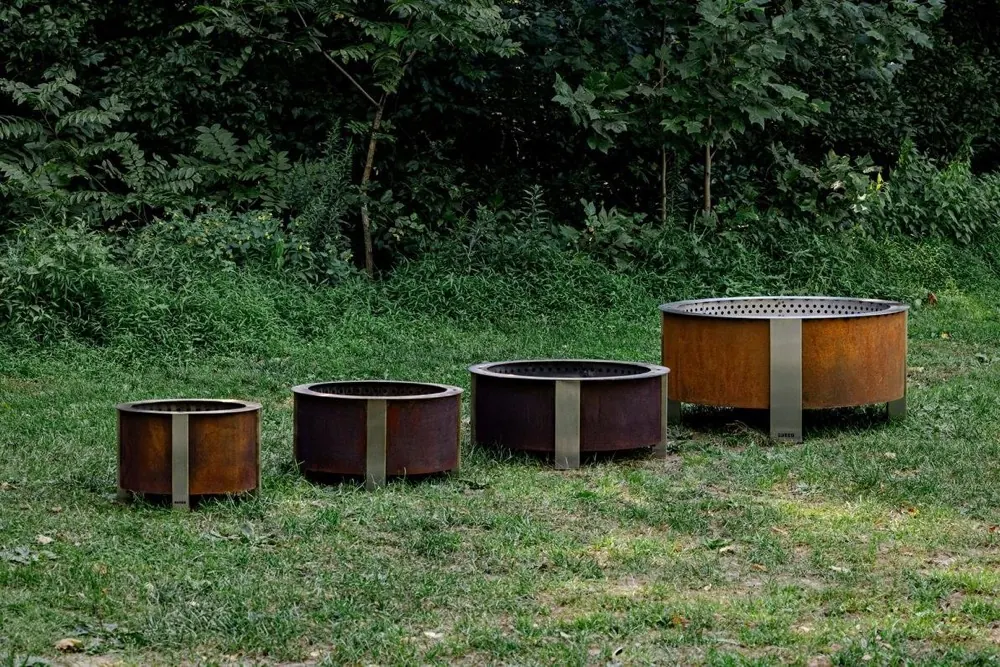
Breeo publishes the numbers, so there is nothing to guess at. Its four X Series sizes weigh 47, 62, 94 and 190 pounds.
People who have owned a lighter pit first are the ones who describe the difference best, and their reviews sit publicly on Breeo's own product page. Breeo is confident enough about them to run several as advertising.
"We bought our X24 after having a Solo Stove Bonfire, and we have loved it ever since. The Breeo X24 just puts out an amazing amount of heat, and you can watch the fire dance for hours."
Jason W., verified buyer, X24 Stainless Steel, January 5, 2024"My old Solo Stove feels like a toy in comparison. I love the X30 way more for both heat output and cooking versatility. If you want a fire pit that doubles as a serious outdoor cooker and will last a lifetime, this is the one."
Joseph L., verified buyer, X30 Corten Steel, April 25, 2025"I owned a Solo Stove for about 5 years, and there is really no comparison. The Breeo firepit is tremendous. An upgrade in both material and design."
Verified buyer, X24 Corten Steel, September 22, 2025"We almost bought a Solo, but so glad we saw our neighbors Breeo. We absolutely love it and wouldn't change a thing."
Frank N., verified buyer, X30 Corten Steel, November 16, 2025The fairest review of the lot is the one that gives the other pit its due, and it is worth reading twice because it describes the actual decision rather than a winner:
We have a solo stove for camping and it is perfect due to size and weight. We wanted something much heavier and stronger for our backyard fire pit. This fits the bill wonderfully. Verified buyer, X24 Corten Steel, September 17, 2025 · published on breeo.com
That is the honest framing. A packable pit answers "what can I put in the trunk". An anchored pit answers "what sits on the patio for the next twenty years and gets cooked on". They are different questions and the same physics.
The second job
The part nobody mentions until they own one
A fire pit with a flat, wide, heavy rim is not only a fire pit. Breeo describes the X Series as "the foundation of the Breeo live-fire cooking ecosystem", and the accessories bolt to that rim: a sear plate that turns the edge into a griddle, an Outpost grill on a post, a kettle hook, a rotisserie. The fire that stopped chasing people around the patio becomes the thing dinner is cooked on.
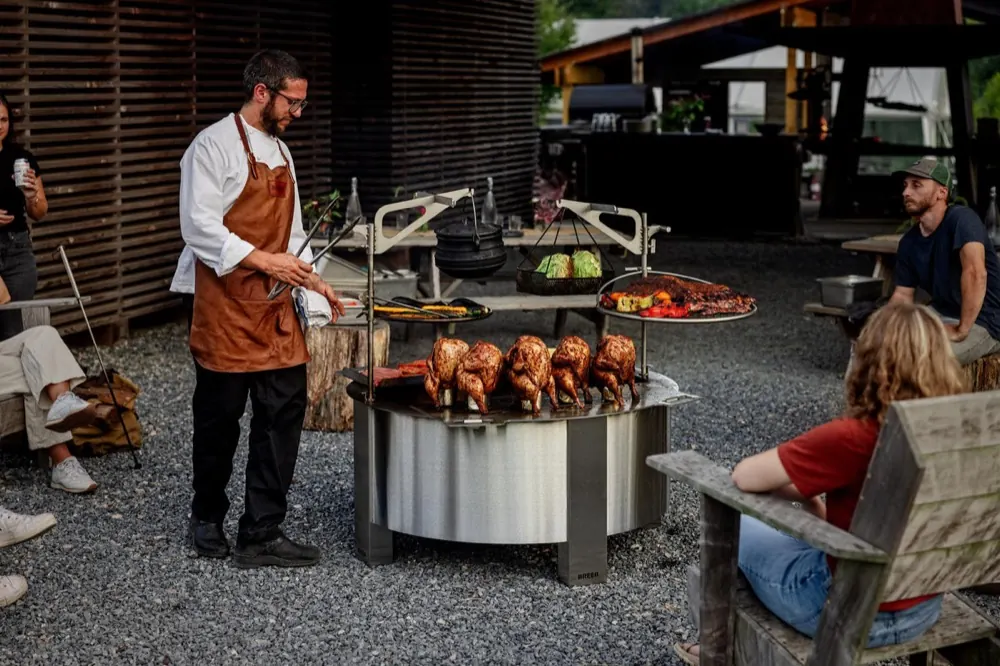
This is where a lot of the enthusiasm in the review feed comes from, and it is not the enthusiasm of people describing a fire:
"We are obsessed. This is our second summer with our Breeo and we literally haven't touched our grill or Blackstone since we got this. It's so great to socialize around while cooking too!"
Nicole P., owner review, May 22, 2026"I have had my X24 for two years now. It is truly smokeless and with the grill on top I can grill ribeyes for 6-8 people in less than 10 minutes at 650+ degrees."
Owner review, X24, November 12, 2025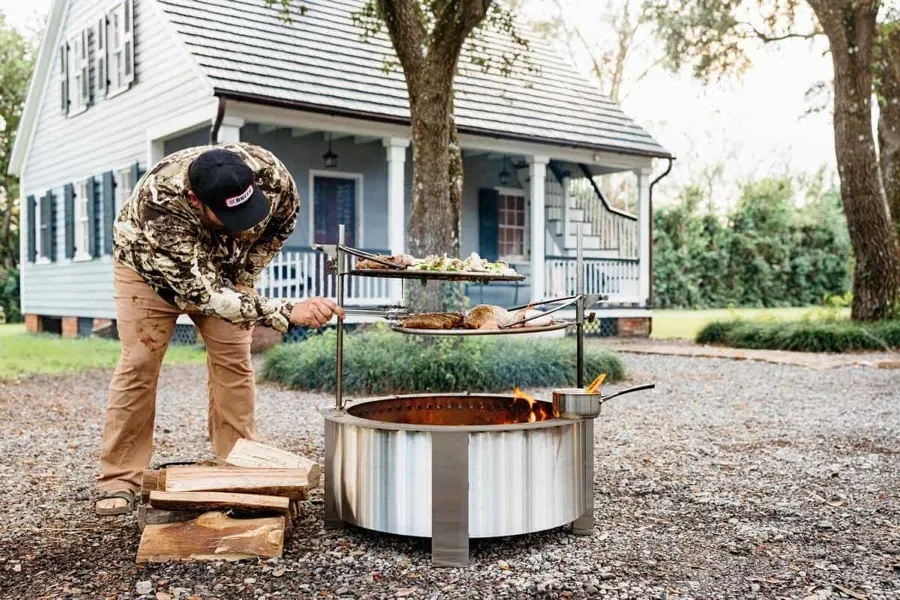
The full live-fire cooking range is on breeo.com, and it is worth a look before choosing a size, because the cooking accessories are what tends to decide between a pit you sit around and a pit you plan meals around.
If you already have a fire pit
The case of the masonry ring
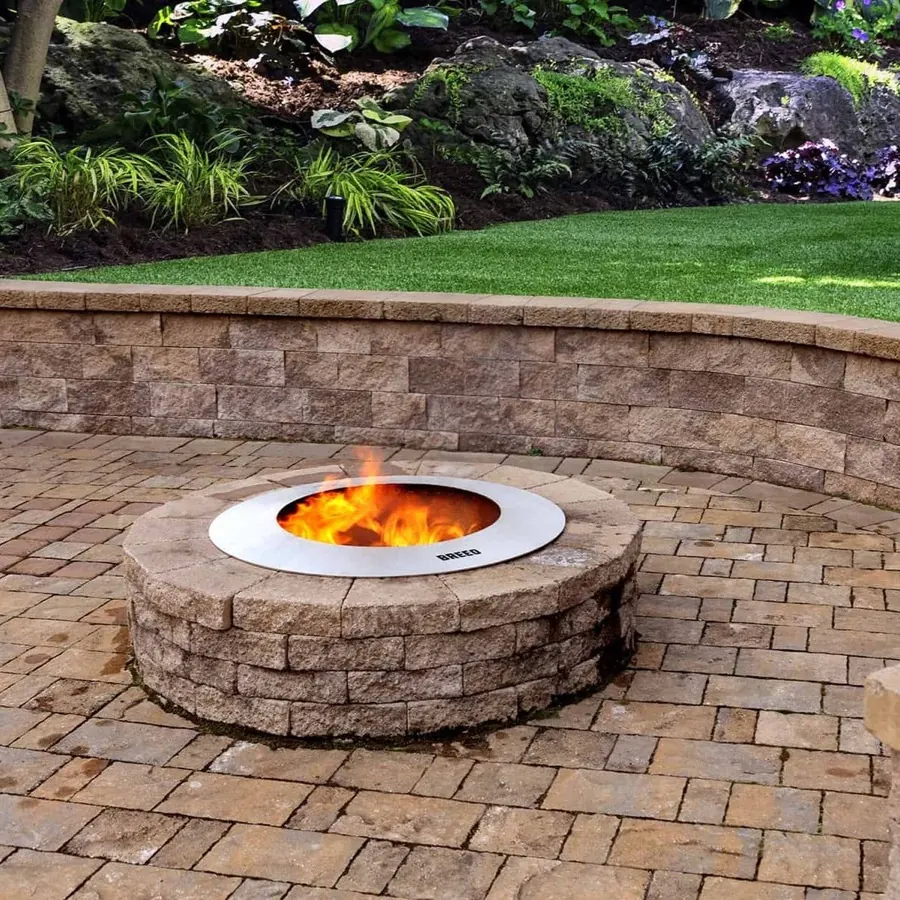
Plenty of houses already have a fire pit: a circle of block or stone that came with the patio, throws smoke in every direction and cannot be moved without a jackhammer. Breeo's answer to that is the Zentro, a stainless insert that drops into the existing ring and turns it into a double wall pit. Their own advertising puts it in one line:
Already have a block fire pit? Give it an instant upgrade. The Breeo Zentro Fire Pit Insert drops right in, no tools, no construction, no smoke. Breeo advertisement running in the Meta Ad Library, August 2026
| Insert | Fits | Price |
|---|---|---|
| 24 inch round | 26 to 32 inch ring | $1,099 |
| 30 inch round | 32 to 40 inch ring | $1,699 |
| 24 inch square | 27 to 33 inch square | $1,699 |
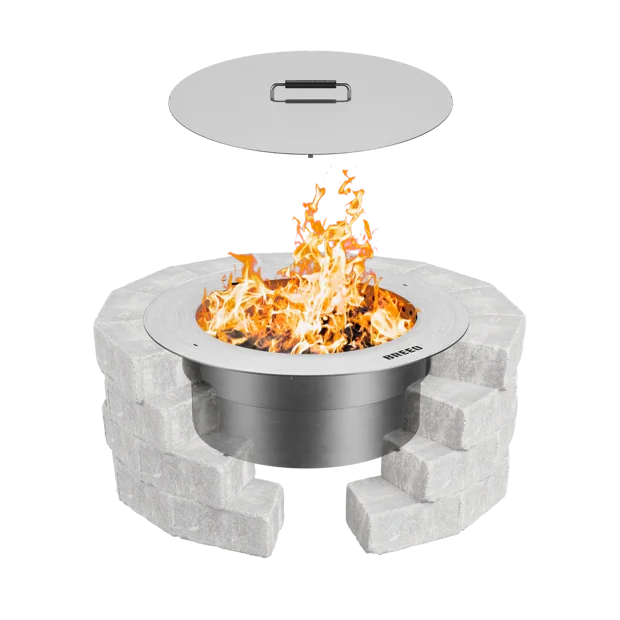
Fits most existing block and stone rings. Measure the inside diameter first.
Choosing
Four sizes, and only two questions
How many chairs, and how long is your firewood. Breeo publishes a recommended log length for each size, which is the spec people ignore and then complain about. Everything below is taken from the specification panel on the X Series page.
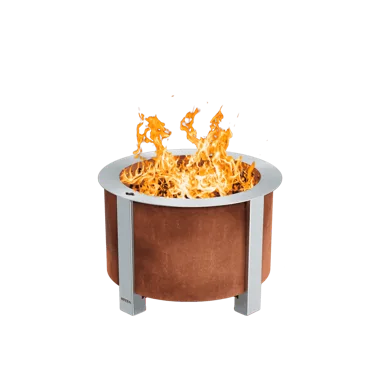
X19
From $399
- 47 lb · 22.13 in outside
- Logs 14 to 16 in
- Fits 2+ chairs
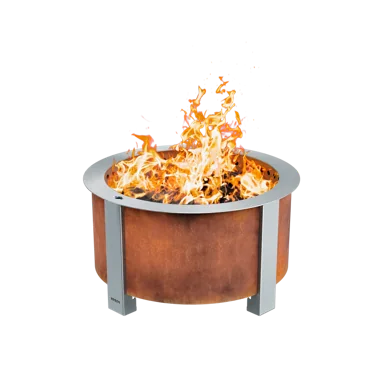
X24
From $599
- 62 lb · 27.5 in outside
- Logs 16 to 18 in
- Fits 4+ chairs
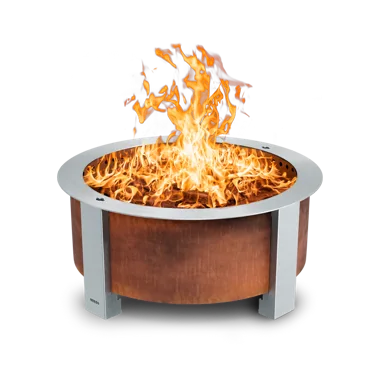
X30
From $1,399
- 94 lb · 34.5 in outside
- Logs up to 24 in
- Fits 8+ chairs
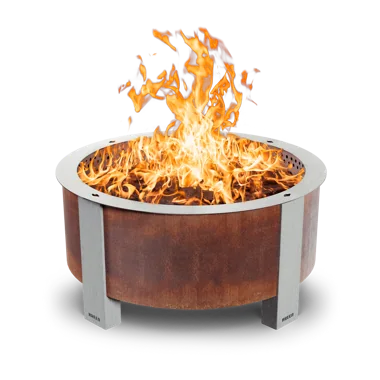
X42
From $2,899
- 190 lb · 46 in outside
- Logs up to 32 in
- Fits 10+ chairs
Then one aesthetic decision. Corten steel is the standard finish and arrives as blue steel that weathers to a rust patina over its first seasons. Breeo calls it weathering steel and notes that the patina "adds protection as it ages". Stainless is 304, adds $100 to $200 depending on size, and stays bright. Both are the same shape and the same mechanism.
Who makes it
Lancaster County, Pennsylvania
Breeo builds in Lancaster County and says why on its own story page, which is more specific than most manufacturing claims manage to be:
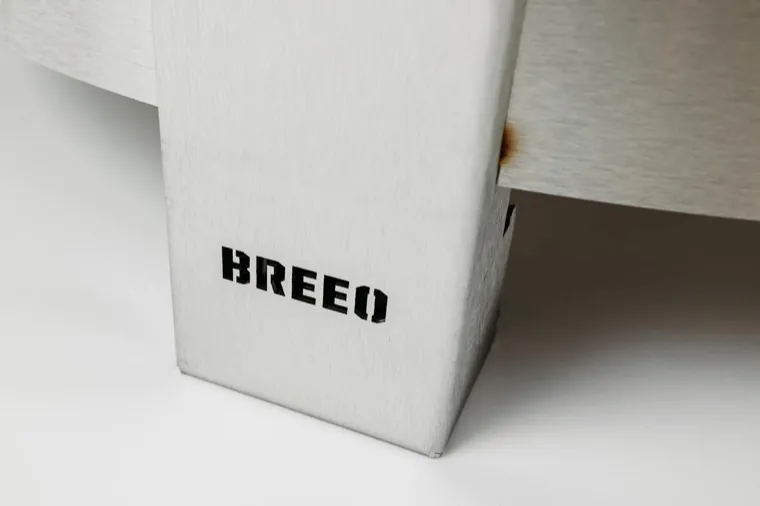
We maintain our base of operations here in Lancaster County, PA to keep a close eye on your fire pit from start to shipping. A large number of our team members are Amish and bring their cultural ethics with them to work each morning. Breeo, Our story
Co-founder Jonathan Miller puts the reason for staying there in one sentence on the same page: "Over generations and generations, Lancaster farmers and craftsmen have built a reputation for quality." Co-founder Amos Stoltzfus adds the operating version of it: "In addition to hard work, trust and loyalty are other core values here, which feed into quality."
The short version
What you are actually buying
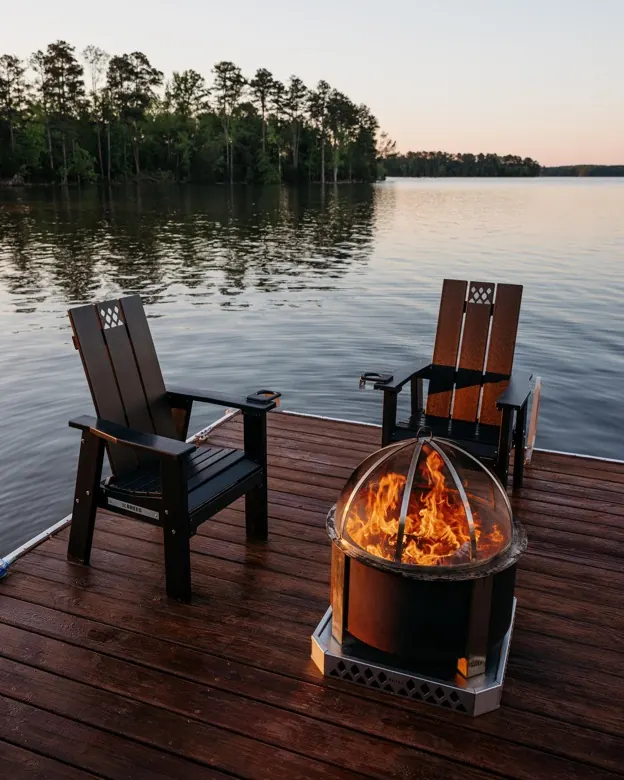
A double wall, a raised vent and a ring of holes. No filter, no fan, nothing to replace. Give it dry wood cut to length and about a quarter of an hour, and the smoke stops picking a person. Give it a heavier wall and it holds that state longer, throws more heat sideways, and carries a griddle.
That is the whole argument, and the reason it survives contact with 4,699 published reviews is that it is a shape rather than a claim.
See the X Series on breeo.comFour sizes from $399. Made in Lancaster, PA. Limited lifetime warranty, 30 day returns.